
Non-Surgical Rhinoplasty
A Disciplined, Safety-Driven Approach to Nasal Filler
Indication Before Injection
You are trained to differentiate:
- True dorsal hump vs. illusion created by low radix
- Saddle deformity vs. mid-vault collapse
- Saddle deformity vs. mid-vault collapse
- Under-projected tip vs. over-rotated tip
- Ethnic nasal variation vs. perceived irregularity
- Surgical vs. non-surgical suitability
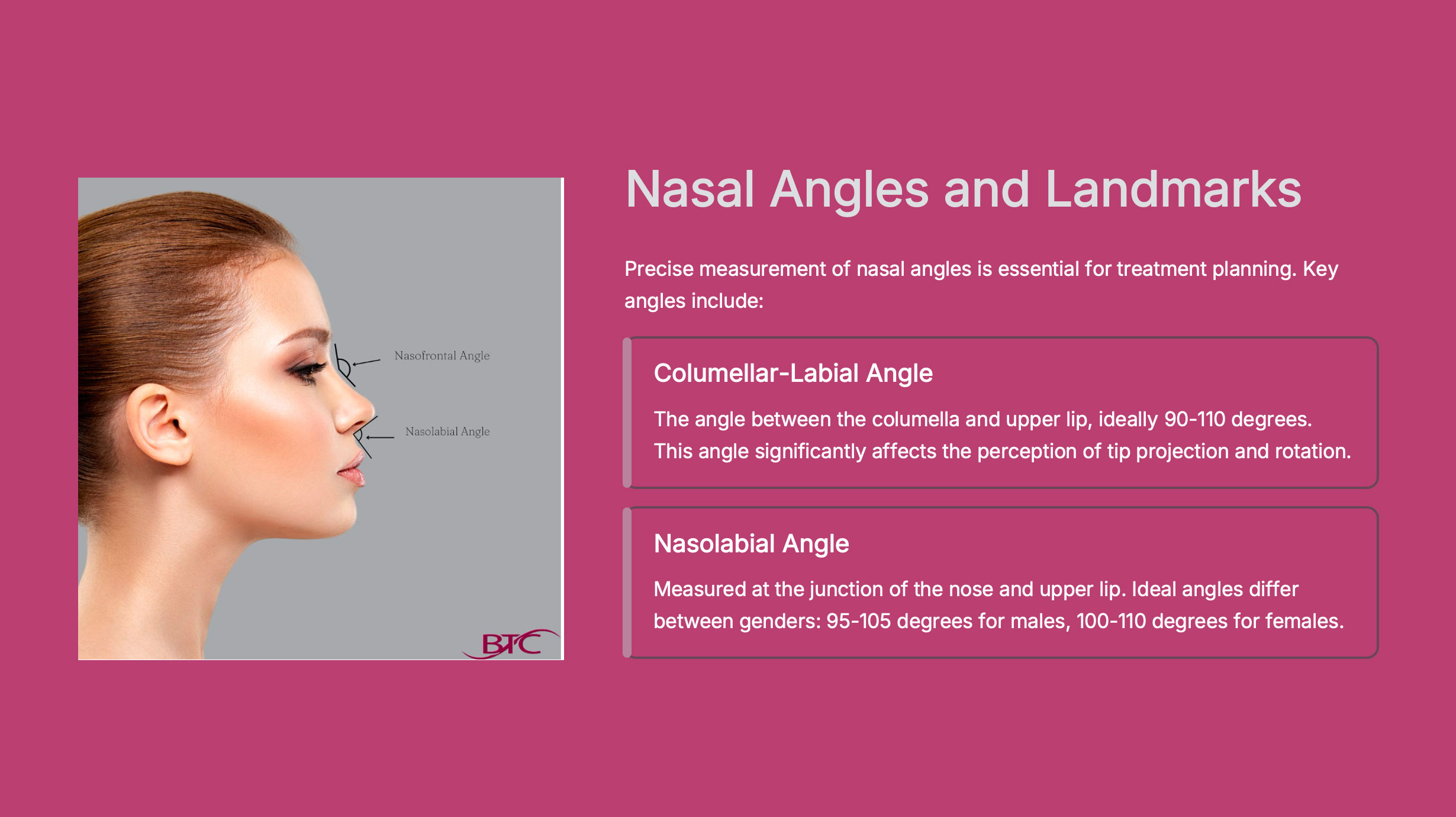
Not every nose should be treated with filler. Learning when to decline is as important as learning how to inject.
Comprehensive Nasal Anatomy & Safety Training
Safety is central throughout.
You are taught that the nasal arterial network communicates directly with the ophthalmic circulation. You are trained to recognise early vascular compromise signs and to have a clear, rehearsed emergency plan. Non surgical rhinoplasty should never be performed without immediate access to reversal agents and a defined complication protocol.
The module covers:
- Nasal vascular anatomy and danger zones
- Radix height assessment
- Dorsal hump camouflage principles
- Saddle deformity correction logic
- Tip projection and support techniques
- Columellar support considerations
- Product rheology for high-risk areas
- Micro-aliquot placement strategies
- Aspiration limitations and safety myths
- Emergency preparedness and occlusion recognition
- Hyalase protocols and escalation pathways
Conservative Structural Illusion — Not Transformation
The emphasis is conservative structural illusion — not transformation.

A dorsal hump is often visually reduced by raising the radix. A drooping tip can appear elevated with minimal structural support. Projection must remain proportionate to chin position and facial thirds.
This masterclass reinforces facial harmony.
The nose does not exist in isolation. Tip projection influences lip position. Dorsal height influences profile balance. Chin retrusion may need correction before nasal projection is attempted.
Precision Service,
Controlled Growth
From a financial perspective, non-surgical rhinoplasty is a high-visibility treatment. Patients seeking nasal correction are often highly motivated and detail-focused. When performed safely and proportionately, subtle structural refinement produces significant perceived improvement — which drives referrals.
However, growth in this area must be controlled.
This is not a high-volume service. It is a precision service.
Predictable ROI comes from:
Comprehensive consultation → Proportion assessment → Conservative correction → Scheduled review → Long-term maintenance planning.
By expanding into non-surgical rhinoplasty responsibly, you reduce the need to refer out appropriate camouflage cases, while maintaining surgical referral pathways for unsuitable patients. This strengthens your authority rather than diluting it.
What You Become After Completion
By completing this module, you become a clinician who:
- Understands nasal vascular anatomy in detail
- Camouflages dorsal humps proportionately
- Projects the tip conservatively and symmetrically
- Maintains immediate reversal readiness
- Differentiates illusion from true structural defect
- Restores saddle deformity with structural logic
- Recognises vascular compromise early
- If you are ready to expand into nasal filler in a measured, anatomically grounded way — this masterclass represents a controlled progression.
- A structured pathway.
- A safe extension of scope.
- A logical investment in long-term clinical authority and reputational strength.
What You Will Receive
You gain comprehensive online theory covering:
- Nasal anatomy in depth
- Including vascular mapping
- Danger zones
- Arterial communication with the ophthalmic circulation
- Why this region demands disciplined, conservative practice
The ageing process and structural variations of the nose are reviewed so you can differentiate between true deformity and optical illusion — such as low radix masquerading as dorsal hump, or chin retrusion exaggerating nasal prominence.
You are guided through a structured assessment of:
- Saddle deformity
- Dorsal hump camouflage
- Radix positioning
- Tip projection and rotation
- Profile balance in relation to chin and lips
- Dorsal hump camouflage and radix elevation
- Saddle deformity correction
- Tip projection and structural support
These demonstrations show full consultation flow, facial proportion assessment, marking strategy, depth awareness, micro-bolus technique and staged refinement. You observe not only injection placement, but decision-making and risk mitigation in real time.
- Early recognition of vascular compromise
- Visual disturbance warning signs
- Immediate dissolution protocols
- Escalation and referral pathways
- Documentation and patient communication following adverse events
In addition to clinical mastery
As with all advanced modules, you also receive practical business integration resources to support safe and predictable expansion. This includes:
- Structured nasal consultation templates
- Proportion and profile assessment frameworks
- Patient screening and exclusion criteria
- Clear expectation-setting guidance
- Compliant promotional examples
- Regulatory clarity regarding POM advertising
- Phased treatment and review planning systems
You are shown how to integrate nasal assessment into full-face consultations, reinforcing that nose treatment must always consider chin projection, lip support and overall facial harmony.
In short, you receive:
- Structured online anatomical theory
- Full PowerPoint learning resources
- Hyalase and emergency management training
- Consultation and documentation templates
- Business-building and retention systems
- Regulatory compliance guidance
- Clinical demonstration videos for dorsal hump, saddle deformity and tip projection
This ensures you are equipped not only to perform non-surgical rhinoplasty, but to assess nasal structure critically, treat conservatively, and expand your scope with discipline, precision and professional responsibility.
This is a £99 investment in long-term competence.